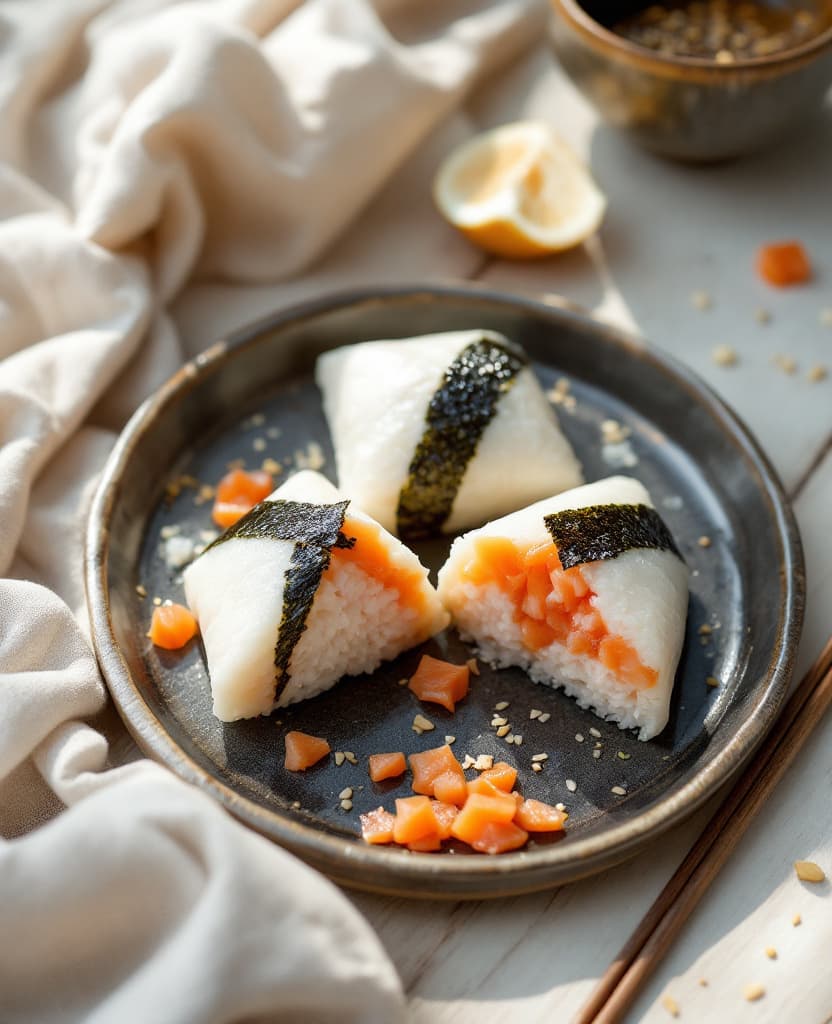
Onigiri, Japanese rice triangles
Warm short-grain rice pressed by salted hands around sour umeboshi or flaked salted salmon, wrapped in a crisp band of nori: Japan's original breakfast to go.
In Japan, onigiri is the breakfast that leaves the house with you. Every convenience store sells them by the thousand before 8 a.m., but the real thing is made at home, by hand, while the rice is still almost too hot to hold. You wet your palms, salt them, and press warm short-grain rice around a hidden center, a wrinkled umeboshi plum or a tuft of salted salmon, then hug it into a soft triangle. The salt is on the outside, where your tongue meets it first. No molds, no fuss, just rice, a little pressure, and a sheet of nori that snaps when you bite. It is the oldest fast food in Japan, and one of the gentlest.
Method
Wash the rice until the water runs nearly clear.
Put the rice in a bowl, cover with cold water, and swirl with your fingers. Drain and repeat 3-4 times, until the water is only faintly cloudy. Drain well, then combine with the 1.75 cups water in a heavy pot or rice cooker and let it soak for 15 minutes.
Cook the rice and salt-broil the salmon.
Bring the pot to a boil over medium-high heat, then cover, drop to the lowest heat, and cook 12-13 minutes. Off the heat, leave the lid on for 10 minutes more. Meanwhile, sprinkle the salmon all over with 1 tsp salt and broil or pan-fry it 4-5 minutes per side, until cooked through and lightly browned at the edges.
Flake the salmon and ready the fillings.
Remove the salmon skin and any pin bones, then flake the flesh into rough shreds with a fork. Pit the umeboshi if needed and tear each plum in half. Set both fillings within reach, along with the bowl of cold water, the salt for your hands, and the nori strips.
Salt your hands and shape the triangles.
Fluff the rice gently and let it cool 5 minutes, until you can just handle it. Dip both hands in the cold water, shake them off, and rub a good pinch of salt across your palms. Scoop about a quarter of the rice into one hand, press a hollow in the center, and tuck in a piece of umeboshi or a spoonful of salmon. Cup the rice closed and press it into a triangle: one palm flat underneath, the other bent into a roof over the top, turning and pressing three or four times. Firm enough to hold, gentle enough that the grains stay distinct. Repeat to make 4 onigiri, re-wetting and re-salting your hands each time.
Wrap in nori and eat warm.
Press a strip of nori along the base of each triangle so it climbs up both faces, shiny side out, and scatter sesame seeds over the salmon ones if you like. Eat right away while the rice is warm and the nori still snaps, with hot green tea and, ideally, no phone.
Frequently asked questions
- Can I use jasmine or basmati rice?
- No, and this is the one non-negotiable. Long-grain rice lacks the surface starch that lets onigiri hold together, so the triangle crumbles in your hand. Look for Japanese short-grain rice, sold as sushi rice, koshihikari, or Calrose in most supermarkets.
- What is umeboshi and where do I find it?
- Umeboshi are Japanese ume plums salted and pickled until intensely sour and briny. One small plum wakes up an entire onigiri, which is why it is the most classic filling in Japan. Any Japanese or pan-Asian grocery carries them in tubs; they keep in the fridge for a year or more.
- Why do I salt my hands instead of the rice?
- It is how onigiri has been made for centuries, and it works. Salt on your wet palms seasons the outer layer of rice, exactly where your tongue lands first, while the inside stays plain to balance the salty filling. Salting the whole pot would flatten that contrast.
- The rice keeps sticking to my hands. What am I doing wrong?
- Your hands are either too dry or the rice is too hot. Dip your palms in cold water and shake off the excess before every single onigiri, and let the cooked rice rest about 5 minutes first. Damp, not dripping, is the target.
- Can I make onigiri the night before?
- You can, with two adjustments: wrap each one tightly in plastic and leave it at cool room temperature rather than the fridge, which turns rice hard and chalky overnight. If you must refrigerate, revive them with 20-30 seconds in the microwave, and always add the nori at the last minute.
Rate this recipe
Join the Club to rate →