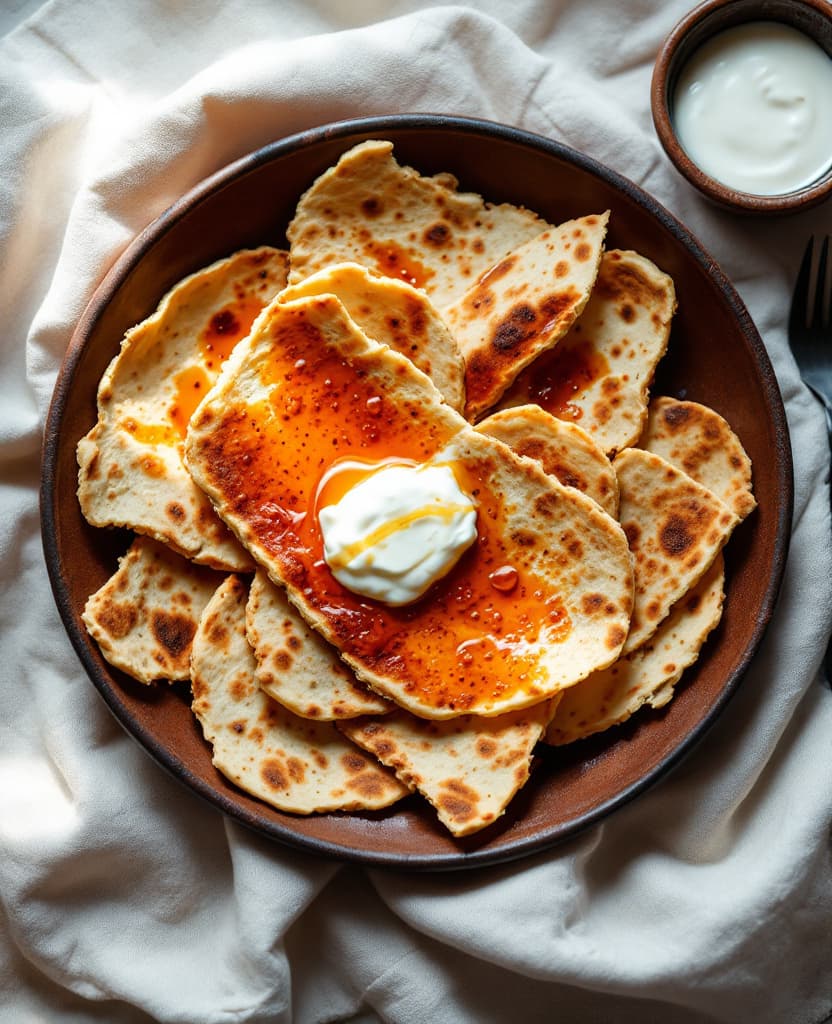
Chechebsa, torn flatbread in spiced butter
A quick pan flatbread torn warm and tossed in golden niter kibbeh and berbere until every piece glistens brick red, finished with a thread of honey.
In Ethiopia, chechebsa is what breakfast looks like when there is no time to wait for injera. Across the highlands it goes by two names, chechebsa or kita firfir, and one method: a quick unleavened flatbread, cooked on a dry pan, torn while still warm, and tossed in niter kibbeh, the golden clarified butter infused with garlic, ginger, and sacred basil that perfumes half of Ethiopian cooking. Berbere stains every piece brick red. Some eat it plain with strong coffee, some drizzle honey over the heat, some cool it with a spoon of yogurt. It is fast food in the oldest sense, ready in the time the jebena takes to boil.
Method
Mix a firm dough and let it sit.
Stir the flours and salt together, then add the water and knead briefly in the bowl until you have a firm, smooth dough, about 2 minutes. Cover and rest for 10 minutes so it rolls out without springing back.
Cook the kita.
Divide the dough in two and roll each piece into a thin round, about 8 inches across. Cook one at a time in a dry skillet over medium heat, 2-3 minutes per side, until speckled brown and cooked through but still pliable.
Tear the bread, bloom the berbere.
Tear the warm kita into rough bite-size pieces. Wipe the skillet, drop in the niter kibbeh over medium-low heat, and when it melts and smells of garlic and ginger, stir in the berbere. Let the spice sizzle gently for 30 seconds, no longer, until the butter turns deep brick red.
Toss until every piece is stained.
Add the torn kita to the pan and toss for 1-2 minutes, turning with a spoon so each piece drinks up the spiced butter and takes on an even red-gold sheen. Some edges should crisp slightly while the centers stay soft.
Finish with honey and yogurt.
Pile the chechebsa into bowls while hot. Drizzle the honey over the top so it melts into the spice, and set the yogurt alongside for cool spoonfuls between bites. Eat immediately, with coffee.
Frequently asked questions
- What is niter kibbeh, and can I substitute plain butter?
- Niter kibbeh is Ethiopian clarified butter slowly infused with garlic, ginger, fenugreek, korarima, and besobela, a sacred basil. It carries much of the dish's flavor. In a pinch, gently melt unsalted butter with a smashed garlic clove, a coin of ginger, and a pinch of ground fenugreek for 10 minutes, then strain. Plain butter works, but the dish loses its perfume.
- How hot is berbere, and what if I cannot find it?
- Berbere is warm rather than scorching: a blend of sun-dried chiles with garlic, ginger, fenugreek, and sweet spices, closer to a complex paprika than a raw chile powder. Start with less if you are heat-shy. There is no perfect substitute, but smoked paprika with a pinch of cayenne, coriander, and ground ginger gets you in the neighborhood.
- Is chechebsa the same as fitfit?
- They are cousins. Fitfit usually means torn injera moistened with sauce or spiced butter, tangy from the fermented flatbread. Chechebsa is made with kita, a quick unfermented flatbread, so it is denser, toastier, and on the table in under half an hour, no fermentation required.
- Do I need teff flour?
- No. Everyday chechebsa across Ethiopia is often made with wheat flour alone. A couple of spoonfuls of teff adds a nutty depth and a nod to the grain that defines Ethiopian baking, but the dish stands perfectly well without it.
- Can I make any of it ahead?
- The kita can be cooked a day ahead and kept wrapped at room temperature; it actually tosses better when slightly dry. Do the butter, berbere, and tossing fresh, it takes 5 minutes, and chechebsa is at its best eaten straight from the pan.
Rate this recipe
Join the Club to rate →